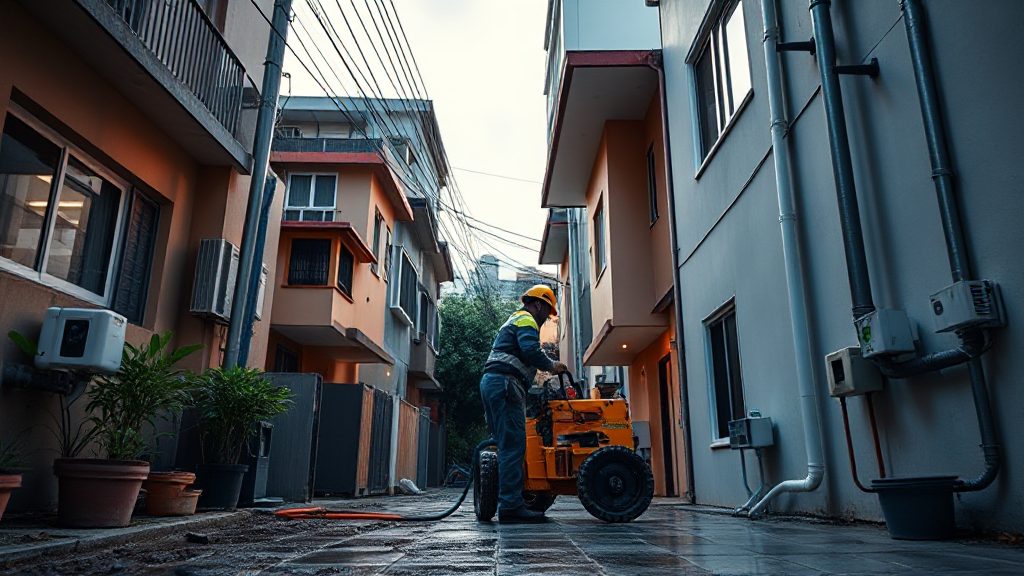
One Stack, Many Homes: Shared Plumbing in Vila Maria Low-Rises
When a ground-floor apartment in Vila Maria floods, the cause is rarely in that apartment. The water backing up through the floor drain usually started as a clog three floors up, in a pipe that every unit above shares. The same stack carries wastewater from every kitchen, bathroom and laundry in the building, and when it blocks, the pressure finds the lowest outlet. That is why residents searching for a desentupidora Vila Medeiros São Paulo SP often discover the real problem is a shared vertical pipe, not their own sink.
Understanding how that shared plumbing works changes how you respond to a backup, how you talk to your neighbors, and who ends up paying for the repair. The sections below walk through the system from the stack to the vent, one component at a time.
The vertical stack: the spine of every low-rise building
The stack is the large vertical pipe that runs from the basement or ground slab to the roof. In Vila Maria’s low-rise buildings, it typically serves all units on every floor, collecting discharge from toilets, sinks, showers and washing machines. Because it is vertical, gravity does most of the work, but the stack depends on air and slope to keep waste moving.
Each fixture connects to the stack through a branch pipe. When a branch or the stack itself narrows with grease, soap residue, hair or paper, water drains more slowly. The first sign is often a gurgling sound from a drain on a lower floor, followed by slow drainage and then a backup. A clog high in the stack can surface as a flood several floors below.
Why lower units feel the problem first
Wastewater always seeks the lowest available exit. If the stack is blocked above a lower unit’s connection, water from upper floors has nowhere to go but back through the nearest open fixture. Ground-floor apartments and commercial spaces at street level are therefore the most exposed, even when their own pipes are clean.
This is also why a single unit’s clog can look like a building-wide emergency. The resident on the ground floor may call a desentupidora Vila Medeiros while the actual obstruction sits two or three floors above, in a section that only a technician with proper equipment can reach.
Branch lines and floor drains: where clogs begin
Most blockages start small, in the branch lines that connect each fixture to the stack. Kitchen sinks accumulate grease and food particles that cool and harden inside the pipe. Bathroom drains collect hair and soap scum. Floor drains in laundry areas and service corridors trap lint and sediment that gradually narrow the passage.
Over time, these local clogs merge into a larger obstruction at the point where the branch meets the stack. Once that junction is restricted, every fixture on that branch drains slowly, and the problem becomes visible to the whole unit. Ignoring a slow drain is the most common way a small branch clog becomes a stack blockage.
The role of floor drains in backups
Floor drains are often the first place water appears during a backup because they sit at the lowest point of the floor. In many Vila Maria buildings, these drains also connect to the same branch as the sanitary fixtures, so a blockage downstream pushes water up through the drain rather than down the toilet.
If a floor drain smells or bubbles when other fixtures are used, the branch is already partially blocked. Addressing it early with a professional inspection is cheaper than waiting for a full backup that affects multiple units.
Venting: the invisible component that keeps water moving
Every stack needs a vent pipe that runs alongside it to the roof. The vent equalizes air pressure inside the system so that water can flow freely. Without adequate venting, draining water creates a vacuum that siphons water from traps, allowing sewer gases to enter the building and slowing the flow.
In older low-rises, vents may be undersized, blocked by debris or improperly connected after renovations. A blocked vent can mimic a clog: fixtures drain slowly, gurgle loudly and sometimes emit odors even when the stack is clear. Vent problems are frequently misdiagnosed as blockages, which is why a proper inspection should check airflow, not just water flow.
Signs that venting is part of the problem
- Gurgling from drains after flushing or using the sink
- Sewer odors inside the apartment that do not go away with cleaning
- Water levels in toilet bowls that fluctuate without use
- Slow drainage across multiple fixtures at the same time
When these signs appear together, the cause is often pressure-related rather than a simple obstruction. A technician can confirm whether the vent is blocked or whether the stack needs hydrojetting to clear accumulated residue.
When the shared stack needs professional intervention
Once a blockage reaches the stack, household tools like plungers and hand augers rarely solve it. The pipe diameter is larger, the obstruction may be several meters away, and access points are limited. Professional equipment such as motorized augers and high-pressure hydrojetting can clear the line without damaging the pipe walls.
Hydrojetting is particularly effective in shared stacks because it scours the entire inner surface, removing grease, scale and sediment that mechanical snakes can miss. For buildings in Vila Medeiros with recurring backups, a preventive hydrojetting schedule is often more economical than repeated emergency calls. A qualified desentupidora em Vila Medeiros São Paulo SP can assess the stack, identify the blockage point and recommend whether clearing or a longer-term maintenance plan is appropriate.
What a professional inspection typically covers
- Locating the blockage using access points and, when needed, camera inspection
- Checking vent connections and airflow through the system
- Clearing the obstruction with the appropriate method for the pipe material
- Testing flow across multiple fixtures to confirm the stack is clear
- Advising on preventive measures for the building
This sequence matters because clearing a stack without checking the vent can leave the underlying cause in place. A blockage that returns within weeks is usually a sign that the diagnosis was incomplete.
Collective responsibility: who maintains the shared system
In a low-rise building, the stack, vent and main drain are common infrastructure. No single resident owns them, and no single resident can keep them clear alone. Grease poured down one kitchen sink, wipes flushed in one bathroom and hair caught in one shower drain all contribute to a problem that surfaces somewhere else.
Building managers and condominium administrators play a central role. Scheduling periodic inspections, informing residents about what should not go down drains, and keeping access points clear can prevent most emergencies. Shared plumbing works best when maintenance is treated as a building-wide practice, not an individual repair.
For residents, the practical takeaway is simple: report slow drains early, avoid flushing materials that do not break down, and coordinate with neighbors when a backup affects more than one unit. When a blockage does occur, calling a specialized service promptly protects lower-floor units from water damage and keeps the whole stack functioning. The pipe that connects every home in the building also connects every responsibility.